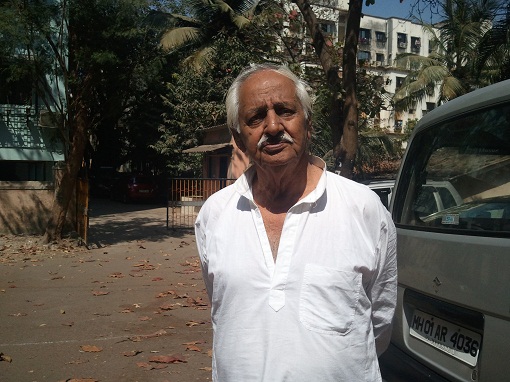

योगेश कुमार शीतल युवा, क्रांतिकारी और तेजतर्रार पत्रकार हैं. देश के सबसे प्रतिष्ठित माने जाने वाले पत्रकारिता शिक्षण संस्थान इंडियन इंस्टीट्यूट आफ मास कम्युनिकेशन से हाल-फिलहाल कोर्स कंप्लीट करके इन्होंने मीडिया की असल दुनिया में कदम रखा है. पिछले दिनों शीतल उस समय चर्चा में आए थे जब इंडिया गेट पर एनडीटीवी वाली और राडिया टेपकांड की खलनायिका बरखा दत्त करप्शन के मुद्दे पर कोई लाइव पब्लिक शो कर रहीं थीं. तब शीतल ने सरेआम यह सवाल बरखा के सामने उठाया था कि जब आप खुद करप्शन के मामले में फंसी हैं तो कैसे करप्शन के मुद्दे पर प्रवचन दे सकती हैं. इसको लेकर बड़ा बवाल हुआ था.
एनडीटीवी वालों ने शीतल को काफी डराया धमकाया. इनके आईआईएमसी के टीचरों से शिकायत की. सबने शीतल को लाइन में लाने की कोशिश की पर शीतल ने खुद को अपनी विचारधारा पर कायम रखके यह बता-जता दिया कि दुनिया में चाहे जितना पतन हो जाए, धरती वीरों से खाली नहीं होगी. शीतल की बात यहां इसलिए हो रही है कि उन्होंने अपने फेसबुक एकाउंट के जरिए एक बड़ा मजेदार आफर रखा है, उन छात्रों के सामने जो इस साल आईआईएमसी से कोर्स कंप्लीट करके मीडिया के असल दुनिया में कदम रखने के लिए कैंपस प्लेसमेंट इंटरव्यू आदि के लिए खुद को तैयार कर रहे हैं. अपनी कहिन के साथ शीतल ने अपना एक अंग्रेजी का लेख भी अटैच किया है जो एक अखबार में प्रकाशित हो चुका है. पहले शीतल की सलाह, और फिर उनका लेख, यहां है. -यशवंत, एडिटर, भड़ास4मीडिया
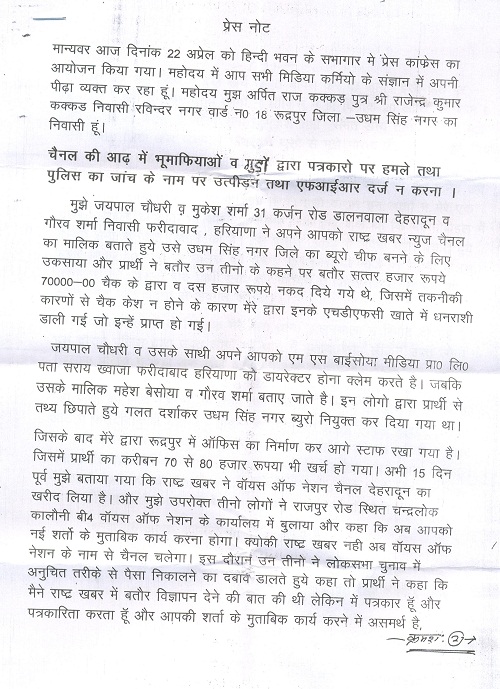
Yogesh Kumar Sheetal : आईआईएमसी में पढ़ रहे साथियों, आपका कैम्पस प्लेसमेंट अब जल्द होने वाला है, बाहर का निर्मम बाजार आपका इंतज़ार कर रहा है. मुंबई की अखवार में छपा ये कोलम पूरी तरह आपको समर्पित है. समय है आपस में एक बैठक करके कैम्पस प्लेसमेंट में आने वाली कंपनी के सामने एक न्यूनतम वेतन का प्रस्ताव आईआईएमसी प्रशासन के माध्यम से रखिये. डरिये मत, इधर हम लोग हैं. आपमें से जो कैम्पस प्लेसमेंट को लेकर ऐसी कोई शर्त पर प्रशासन को झुकाने में सफल होगा, उसे मेरी तरफ से पी. साईनाथ की एक किताब उपहार में दी जायेगी. शुभकामनाएं.
Media Studies in India : Miles to go

YK Sheetal
It would had been better if Justice Markandey Katju had been noted on the media study and a build up of media institution in last few years in metro cities, too, as he earlier candidly remarked on the intellectual worth of media persons, specially in mainstream, during lashing out at Indian media in an interview with a news channel. Fascinatingly, Media, which is in paranoia, after Katju’s slap on it’s activity and had been badly criticised for it’s flawed behaviour in civil society and must be x-rayed by one more angle right now to disclose some hidden fractures.
The grass root problem of Indian Media is not only infrastructural designing but also the quality of man power in a broad prospect. How can anyone expect a good and ideal family without having a bunch of healthy members? Is it possible? No, of course, because ideas and understandings have a key role in building an ideal family and without having such ornaments family would be like a widow. Correspondingly anyone can’t anticipate an objective and dutiful media until and unless the manpower, who is devoted to concerned Press, would be of that level.
‘‘People, who are good at writing and have outstanding communication skills can opt for journalism. A career in journalism brings with it many challenges. With the arrival of so many news channels, journalists have scope for ample growth and are paid good remuneration. You may also work with the leading Hindi and English newspaper of your city’’ according to an advertisement of a Delhi based private media institution.
Unquestionably, being a good writer is an essential spirit for a good author but it can never be a guarantee for a good journalist. If truth prevailed everywhere then there was no need of copy editor or proof editor in a newspaper or news channel. The soul of journalism is watch dog except representation. Representation is the secondary process but where the process starts need a keen observation, information and imagination. It can be better understood by photo journalism. Photo journalism is an art according to which someone searches a message in the blue, which are normally overlooked by everyone. Editing and presenting that picture by using softwares are the secondary process and must not be defined as the supreme part of journalism. There are so many examples in Hindi language state where stringer of news channels as well as mufassil reporter doesn’t have any degree or certificate of a media institution, still their work catches audience’s attention. P Sainath, a renowned journalist of the world also mentioned respectfully by Katju during that interview, has been a student of history from JNU, New Delhi. Even majority of contemporary journalists belong to the same background including Law, Literature, Science, Arts except an authentic degree or certificate of Journalism from any institute. According to P Sainath, ‘There are two kinds of journalists. While of those are journalists, the other are stenographers’. Now, certificates and degrees of journalism are the gate pass for entering in any Media Houses.
In fact, the structure of Media institution in India must be scanned in big sphere. The number of university-qualified journalists continues to grow all around the world including India, but the quality of journalism has declined universally in proportion to the technical hype. It’s hard to believe now that anyone can become a journalist without possessing an authentic certificate of journalism. If you choose not to get a journalism degree, it might be okay for a while, but it is likely to be a decision you will eventually regret. It clearly means you will have to achieve a degree to cross check the point of journalism, specially in Metro cities.
According to Francis Wade, writer and sub-editor for Democratic Voice of Burma, “When deciding on a school for journalism studies, the key factor is whether your place of choice effectively balances the hands-on, practical side of reporting with a good insight into how the media industry works. Both play key roles in the quality of your output and in helping you to understand the credibility of whatever organisation/institution you choose. The majority of media groups are increasingly sacrificing good journalism for material that can be generated quickly and that satisfies a mainstream audience, regardless of the strength of the story, and a strong school should help you to develop both a sharp insight into how the industry functions, and equip you with the necessary tools to make you a driven, but sensitive, journalist.”
Now the burning question is of balances among the definitions of journalism. Of course, you can’t weight out all kinds of journalism equally. For example, ‘Wikileaks has a difference in opinion with Aljazeera’. We must not forget that the source of economy of any media houses decide what should be the definition of journalism. In the era of Brand Capital, Private Treaty, Media Partner, Paid News etc, the definition of journalism and media has been changed. Earlier, this stream was defined as the fourth pillar of democracy. If Julian Assange or Jimmy Wales are looking for economic help, it can’t be ignored as just news. In India, a famous Hindi web portal requested for donation from it’s audience, too. No need to say that after 2009 Paid News episode and Nira Radia Tape controversy the definition of Media has been changed drastically.
Now, coming to the point, Indian education system in itself is suffering so many challenges due to lack of good policies. Indian institutions don’t find a mention in the world’s top ten list. The situation is even worse in the field of Journalism. Government Media institutions are at par with Prasar Bharti, where seats continue to remain vacant. As number of media channels is rising day by day, private media institutions too are growing up correspondingly but number of government Journalism Colleges are in stand by mode! Indian Institute of Mass Communication, a prestigious Government Media Institution, is on hold for 3 years, at least, for allowing Master Degree in Journalism and Mass Communication! In the mirror of IIMC, one can identify with the government awareness towards Journalism education. In the era of LPG (Liberalisation, Privatisation and Globalisation), such policies boost Private Sector to fly as it can and the consequences of that policy has been seen on the ground where at least, more than hundred Private Media Institutions emerge in the streets of New Delhi and other Metro cities with a new definition of Media, Mass Communication and Journalism in too, where target audience, TRP and Market values have more regard than ethics, morality, reality, truth, objectivity and all what Markandey Katju talked about.
Let’s welcome a counter of Andrew Spooner, a renowned blogger and travel writer for The Guardian, according to whom “Having taught Journalism to undergraduates, I would probably ask something about what links they have to the industry. Do they have good quality guest speakers and some lecturers with a proven and published track record? In the UK do they think to NCTJ courses, or if elsewhere, do they promote similar standard? Do they also promote critical thinking and engage student on broader issues? It is easy to teach student to do things-harder to get them to actually think what/how/why they are doing it.”
In India, almost all channels inaugurated their Media schools during last few years. Was it for teaching Journalism? Yes. Which type of journalism? This question is still unanswered because of so many definitions of journalism exist after globalisation in India. Most of these colleges don’t even have a proper library or group discussion programmes which is mandatory for any media institution, still these institution are making progress day by day. The fee structure of private institution starts from 2 lakhs onwards. Clearly students, who join such institutes, speculate a job after courses by so called campus placements so that he or she could get money back what he or she invested in study. Even, there’s no standard entrance exam or interview for admission at all except for some private Media institutions. Everyone knows the Hindi journalism students of IIMC have been placed in different Media houses at a remuneration of Rs 6000 to 7000 per month. IIMC is one among the reputed library holder in the world and organises all India level entrance examination still less than 40 per cent student in session (2009-10) have been placed with average remuneration of Rs 7000 per month in Hindi Journalism.
Now, analyse a news published recently from Allahabad dateline of a Delhi based Hindi newspaper. “Chand kee tasdik ke sath aai khushiyan, aaj se muharram” is just an example of what’s going on in Media. Who cares? One famous incident must be underlined here. In 1993, Sainath applied for a Times Of India fellowship. At the interview he spoke of his plans to report from rural India. When an editor asked him, “Suppose I tell you my readers aren’t interested in this stuff”, Sainath riposted, “When did you last meet your readers to make any such claims on their behalf?’ It’s the time when the burning questions concerning media studies must be discussed otherwise it will be too late.
http://www.afternoonvoice.com/column_Media-Studies-in-India-Miles-to-go_26_12_11.html