Hiring today looks efficient on the surface. You post a job on Naukri, LinkedIn Jobs, Indeed, Apna, Shine, or Foundit, pay for visibility, and wait for applications. But most recruiters already know how this plays out. Some roles attract a flood of irrelevant CVs. Others barely get responses. The inconsistency is not random. It is built into how these platforms work.
The limitation no one talks about
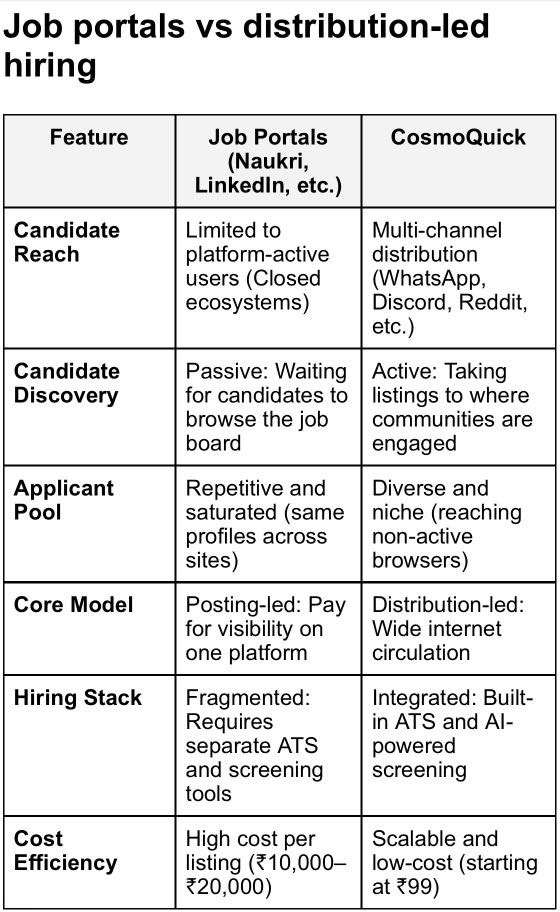
All major job portals operate as closed ecosystems. Your job listing on Naukri is visible only to Naukri users, a post on LinkedIn Jobs is limited to LinkedIn’s active audience, and a job on Indeed only reaches Indeed’s existing pool. Whether you use Apna, Shine, or Foundit, your reach is strictly confined to that platform’s user base. This structural limitation means that no matter how much you pay for visibility, your job is only circulating within a closed, saturated talent pool, forcing every recruiter to compete for the same set of profiles.
Where candidates actually are
Candidate behavior has shifted, but hiring infrastructure has not kept up. A large number of quality candidates are not actively browsing job boards anymore. They spend time in:
- WhatsApp and Telegram groups
- Discord communities
- Reddit threads (often exceed 100,000 active users)
- Niche LinkedIn and Facebook groups (often have 40,000–500,000+ members)
- Social platforms like X
Traditional platforms miss out on millions of potential candidates found in these engaged communities.
These are high-engagement environments where real conversations happen. Most job portals do not reach them.
Why this hurts agencies more
For recruitment agencies and high-volume hiring teams, the inefficiency compounds. Multiple open roles, rising listing costs, and pressure to deliver quickly create a difficult equation. Paying ₹10,000–₹20,000 per listing repeatedly becomes hard to justify when the reach remains limited and outcomes are inconsistent.
The shift: from posting to distribution
The underlying issue is not visibility. It is distribution. Hiring is no longer about placing a job on a platform and waiting. It is about getting that job in front of the right candidates across the internet. This means moving beyond a single platform’s user base and expanding reach into communities where candidates are already active.
Where CosmoQuick fits in
CosmoQuick is built around this shift. Instead of functioning purely as a job board, it focuses on distributing job listings across multiple platforms and communities. The idea is simple: Do not wait for candidates to come to the listing; take the listing to where candidates already are. This model positions CosmoQuick not just as another site, but as a superior alternative to the entire fragmented job portal ecosystem.
- Live job listing on CosmoQuick with 100,000+ users
- Access to 700M database reach
- 5M+ social media circulation reach
- 6M+ Google impressions for additional visibility
- Promotion in relevant groups, communities, and niche hiring networks
- Distribution across channels such as Reddit, Telegram, Discord, and social platforms
- Built-in ATS (Applicant Tracking System) to manage applicants
- AI candidate ranking for faster shortlisting
- AI screening tools to reduce manual filtering
- Optimized job description support to attract stronger applicants
- Offer letter generator to streamline hiring workflows
- Interview preparation tools for smoother recruitment processes
- 30-day live listing period for continued applicant flow
- Better off-platform reach instead of relying only on one job portal
At the core of this advantage is the single ₹99 job post, which bundles a massive distribution network with a complete, integrated hiring stack. This isn’t just a post; it is an entry point into a multi-channel reach that includes access to a 700 million database, circulation across social media reaching over 5 million people, and more than 6 million Google impressions. By bypassing the closed ecosystems of traditional portals, CosmoQuick ensures your role is visible where talent actually congregates.
For startups and lean teams, this combination shifts hiring from mere placement to a focus on outcomes, distribution, and cost-efficient execution. It provides the heavy-duty infrastructure of a global recruitment firm at a fraction of the cost, making it the most effective way to scale in a competitive talent market.
In practical terms, this shifts hiring from just placement to a combination of reach, filtering, and execution.
What this means going forward
Job portals are not going away. They still serve active job seekers and provide structure. But they are no longer enough on their own. Hiring is moving toward broader reach, faster cycles, and systems that combine distribution with execution.
Final thought
If you rely only on Naukri, LinkedIn Jobs, Indeed, Apna, Shine, or Foundit, you are competing for the same candidates as everyone else. The advantage now comes from how widely and intelligently your jobs are distributed.
That shift is already underway. CosmoQuick is one example of how hiring platforms are starting to adapt.